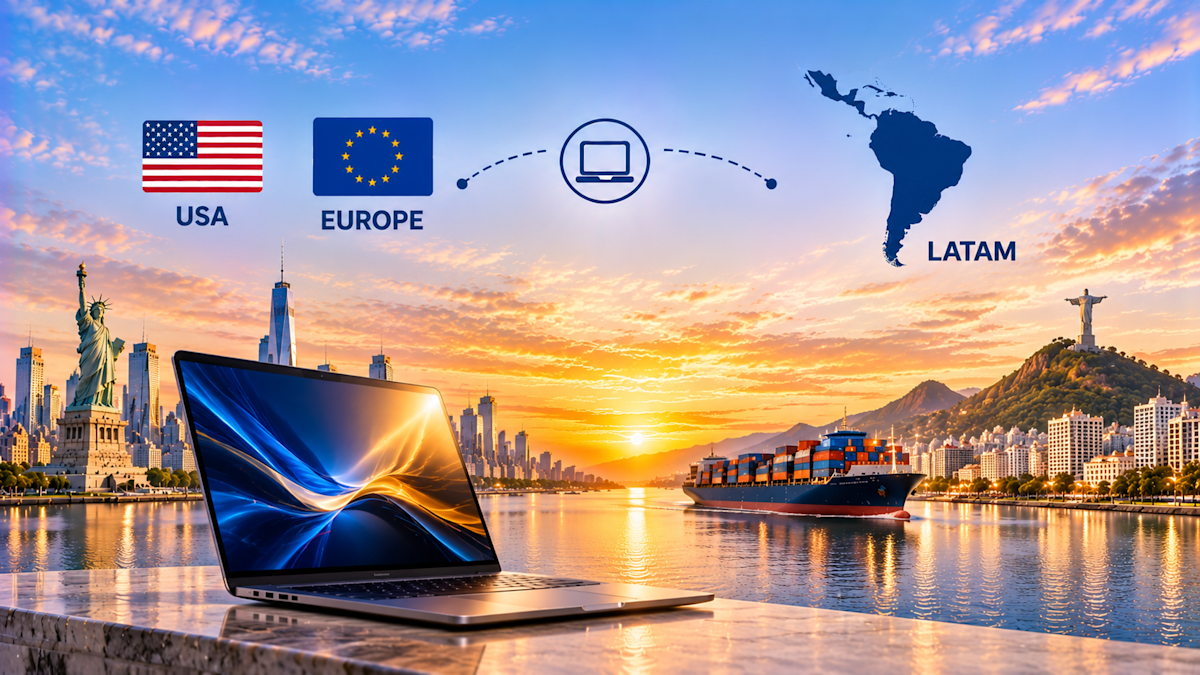
Latin America has no single customs regime: a laptop that clears Chile with 6% duty and 19% VAT faces 60% import tax plus state VAT in Brazil. Every country does share one rule, though: the courier needs the employee's tax ID before the parcel is released. This procedure helps US and European teams ship a laptop to an employee in Brazil, Mexico, Colombia, Argentina or Chile, and flags what changes country by country.
Estimated time: 1 to 3 hours of preparation per device, depending on the country · Level: advanced · Prerequisites: the employee's national tax ID, the device's model and serial number, your EORI if shipping from the EU · Verified on: regulations of the five countries, the US and the EU as of November 2026
What changes from one LATAM country to the next
Three variables decide how hard a shipment is: the ceiling of the simplified courier channel, the tax on a laptop in that channel, and the tax ID the courier must print on the waybill. The table covers the five largest remote-hiring markets in the region; check the detailed guide for Brazil, where the rules are heaviest.
Country | Courier channel ceiling | Taxes on a business laptop | Recipient ID |
|---|---|---|---|
Brazil | US$3,000 customs value, freight included | 60% import tax, plus ICMS of 17% to 20% | CPF |
Mexico | US$2,500 for the simplified courier procedure | Flat 19% global rate on goods not of US, Mexican or Canadian origin | RFC |
Colombia | US$2,000 | 10% tariff plus 19% IVA | Cédula or NIT |
Argentina | US$3,000 per shipment | Import duty per tariff line plus 21% IVA; first US$400 duty-free for personal use | CUIT or CUIL |
Chile | Above US$500, the general import regime applies | 6% customs duty plus 19% IVA on the CIF value | RUT |
Sources: Brazil (Receita Estadual RS, Receita Federal); Mexico (trade.gov, Dutify); Colombia (DIAN); Argentina (ARCA Resolution 5608/2024, via Diario de Cuyo); Chile (Servicio Nacional de Aduanas, FedEx).
Step 1: Check the laptop fits the destination's courier channel
Start with the ceiling, in US dollars, because it decides whether the laptop can travel as an express parcel or needs a formal import with a customs broker. Convert the full value, freight and insurance included, and keep a margin for exchange-rate moves if you price in euros.
Brazil: the simplified regime stops at US$3,000 of customs value (Receita Estadual RS). Above it, a broker and a registered importer are required.
Mexico: courier and express companies must hold the recipient's own RFC for shipments under US$2,500 (trade.gov).
Colombia: the postal and express channel covers shipments up to US$2,000 (DIAN).
Argentina: the courier regime accepts up to US$3,000 per shipment (Diario de Cuyo).
Chile: above US$500, the general regime applies with duty and IVA (Servicio Nacional de Aduanas).
Check telecom approval as well. Brazil is the strictest case: laptops with Wi-Fi or Bluetooth should be Anatel-homologated (Anatel). For other countries, ask the carrier whether the exact model needs a local approval.
How to check it worked: the converted customs value sits under the destination's ceiling with a margin.
Step 2: Collect the employee's tax ID and local address
Across the region, the recipient's tax number is what lets the courier clear the laptop through the simplified channel. Without it, the parcel either waits or moves to a slower, more expensive formal procedure. Ask for the number and the address as the employee would write them locally.
Brazil: CPF on the invoice and waybill, plus the CEP postcode.
Mexico: the recipient's own RFC; generic taxpayer numbers have not been accepted for courier imports since 15 October 2024 (trade.gov).
Colombia: the cédula, or NIT for a company recipient (GroWrk; Springer Nature).
Argentina: CUIT or CUIL. The duty-free US$400 allowance applies to the first five shipments per person each year (Perfil).
Chile: RUT on the air waybill and the commercial invoice (FedEx).
How to check it worked: the employee has confirmed their tax ID and full address in writing, with the name exactly as registered.
Step 3: Secure the laptop before it leaves
Prepare the laptop so that it is useful the day it arrives and protected if it is held at customs, which can take days in some LATAM markets. That means enrolling it in your device management tool, encrypting the disk and removing anything that should not travel, before it goes into the box.
Enroll the device in your MDM so it can be locked or wiped remotely.
Turn on disk encryption (FileVault on macOS, BitLocker on Windows).
Remove local admin accounts, saved passwords and data the employee doesn't need.
Record the serial number for the invoice.
How to check it worked: the device shows as managed and encrypted in your MDM console.
Step 4: Handle the export side: US filing or EU declaration
The departure formalities depend on where you ship from, not where the laptop is going. One commercial invoice serves both sides: exact description, HS code 8471.30, serial number, real value, freight, country of origin, the employee's tax ID, and the purpose (company equipment for an employee, not for resale).
From the US. Electronic Export Information must be filed in AES when the value per Schedule B number is over $2,500, or when a license is required (trade.gov). Check the manufacturer's ECCN for the destination.
From the EU. An express consignment worth up to EUR 1,000 and not liable for export duty is deemed declared at the office of exit with its transport documents (European Commission). Above that, a standard export declaration under your EORI returns an MRN. A supply shipped outside the EU can be invoiced without VAT if the exit is proven (EUR-Lex, CJEU C-563/12).
How to check it worked: you hold the EEI's ITN or exemption (US), or the MRN or transport document (EU).
Step 5: Budget the destination's taxes and book DDP
Taxes on a laptop range from roughly a quarter of its value in Chile to close to its full value in Brazil, so get the estimate approved before booking. Book with duties and taxes billed to your company (DDP), so the employee doesn't receive a payment request before delivery.
Trade agreements rarely help here. Preferences such as USMCA in Mexico or the US-Chile agreement depend on where the laptop was made, not where it ships from, and most laptops are manufactured in Asia. Mexico's flat 19% courier rate, for example, applies to goods that don't originate in the US, Mexico or Canada (Dutify). In Chile, the 6% duty and 19% IVA apply to the CIF value (Servicio Nacional de Aduanas): a US$1,000 CIF laptop pays US$261.40.
How to check it worked: the booking shows DDP and the tax estimate is approved in your currency.
Step 6: Pack the laptop and declare its battery
A laptop travels with its lithium-ion battery installed, which makes it a regulated item for air transport. Most business laptops use batteries of 100 Wh or less, which fall under the simplified rules for batteries contained in equipment. Pack it so it cannot move or switch on, and label it the way the carrier expects.
Under IATA Packing Instruction 967, Section II applies to lithium-ion batteries of 100 Wh or less contained in equipment (DHL guide, IATA DGR):
Switch the laptop off completely and pack it with its charger.
Use a rigid box with cushioning on all sides.
Declare the battery at booking so the carrier applies the UN3481 mark.
How to check it worked: the carrier accepted the booking with the battery declared.
Step 7: Track clearance and confirm delivery
Clearance times vary more in LATAM than in most regions: DHL Express Colombia, for example, indicates that a standard nationalization can take up to 15 days (DHL Colombia). Brief the employee to answer carrier messages quickly, since a missing tax ID or address detail is the usual reason for a hold.
When the laptop arrives, ask the employee to power it on and confirm it reports in your MDM. Keep the invoice, export proof and tax receipts together in your IT inventory: returning a laptop from the region later requires its own export formalities.
How to check it worked: the device is delivered, powered on and reporting in your MDM console.
Mistakes that block laptops across LATAM
The same handful of errors blocks laptops across the region, whatever the destination. Most can be avoided at booking.
Mistake | Fix |
|---|---|
No tax ID, or a generic one, on the waybill | Collect the employee's CPF, RFC, cédula, CUIT/CUIL or RUT before booking |
Value checked without freight, or in euros only | Convert the full customs value to US dollars against the courier ceiling |
Expecting a trade agreement to remove duties | Check where the laptop was manufactured; Asian-made laptops rarely qualify |
Taxes left to the employee (DAP) | Book DDP, especially for Brazil, where taxes can approach the device's value |
Model not approved in Brazil | Check the exact model number in Anatel's system before shipping |
Going further
Shipping one laptop at a time works for a first hire in the region. Beyond that, the taxes in Brazil and Argentina, the clearance times and the returns quickly make local sourcing the cheaper route, because the device never crosses a border. Fleet delivers IT equipment to employees in more than 150 countries, pre-enrolled in your MDM, through local suppliers (Fleet).
For Brazil, follow the detailed procedures from the US or the EU. For rules shared by every region, see our complete guide to shipping a laptop to a remote employee, or explore Fleet's laptop shipping service for remote employees.
Recap checklist
Destination identified and customs value, freight included, under its courier ceiling
Telecom approval checked (Anatel for Brazil)
Employee's tax ID and local address confirmed
Device enrolled in MDM and encrypted, serial number recorded
US: EEI filed if above $2,500 / EU: EORI, MRN if above EUR 1,000, VAT-free invoice
Destination taxes estimated, approved and booked DDP
Lithium battery declared, laptop packed switched off
Delivery confirmed in MDM, export and import documents filed together
Equip teams across Latin America with Fleet
Hiring across LATAM means a different courier ceiling, tax bill and tax ID in every country: a CPF and 60% import tax in Brazil, an RFC in Mexico, a CUIT in Argentina, a RUT and 6% duty in Chile, plus US or EU export filings on departure. You can handle it country by country, but each shipment adds time, risk and cost.
Fleet runs the entire process end to end in one platform, across 150+ countries, from the moment someone signs their offer to the day they leave:
Local sourcing: buy or lease Macs and PCs from Fleet's catalogue, sourced locally so courier ceilings and import taxes drop out of the process
Delivery across the region: devices are delivered to employees in 150+ countries in under 5 days
Ready on day one: laptops arrive pre-configured, with your security policies enforced through Fleet's MDM
Real-time visibility: every device, OS version and compliance status tracked in one dashboard, whatever the country
Onboarding and offboarding: when someone leaves, Fleet retrieves, wipes, stores and redeploys the device locally, with no re-export
Warranty and repairs: 100% warranty coverage, repairs and a loaner device for the whole contract
Book a demo and see how Fleet helps you equip teams across Latin America.
FAQ
What is the cheapest LATAM country to ship a laptop to?
Among the five covered here, Chile usually costs least: 6% duty and 19% IVA on the CIF value, around 26% in total. Brazil is the most expensive, with 60% import tax plus state ICMS on courier imports.
Do I need the employee's tax ID to ship a laptop to Latin America?
In practice, yes, everywhere covered here. Couriers need the CPF in Brazil, the RFC in Mexico, the cédula or NIT in Colombia, the CUIT or CUIL in Argentina and the RUT in Chile to clear the parcel under the simplified channel.
Does USMCA make laptops duty-free when shipped from the US to Mexico?
Only if the laptop qualifies as originating in the US, Mexico or Canada. Most laptops are made in Asia, so shipping from a US address doesn't change their origin; Mexico's flat courier rate then applies.
Is shipping from Europe to Latin America different from shipping from the US?
The destination rules are the same, but the export side differs: from the EU, laptops above EUR 1,000 need a standard export declaration under your EORI, and the invoice can be VAT-free if the exit is proven. From the US, the EEI filing threshold is $2,500.
Conclusion
A laptop reaches an employee in Latin America without a customs hold when its full value fits the destination's courier ceiling, the employee's tax ID is on the waybill, the US or EU export is documented and the local taxes are prepaid. For Brazil, use the dedicated guides.
See how Fleet handles this in practice
200+ devices, sourced locally and delivered pre-configured to 150 countries — buy or lease, same price.